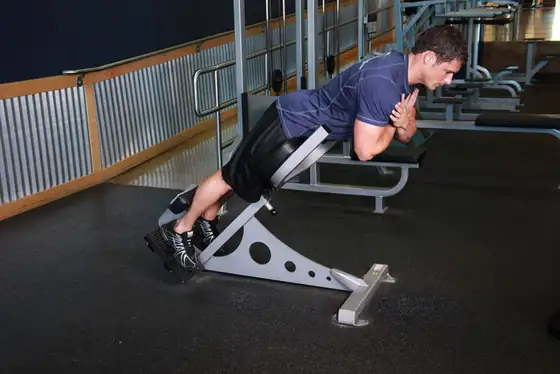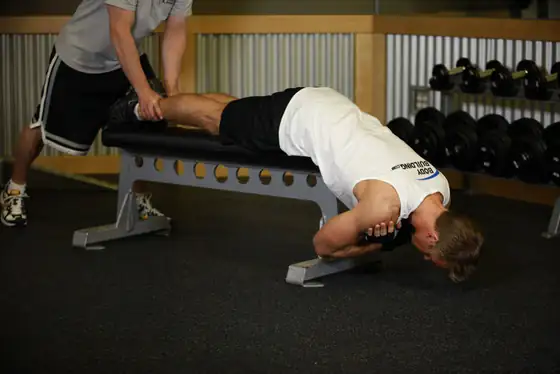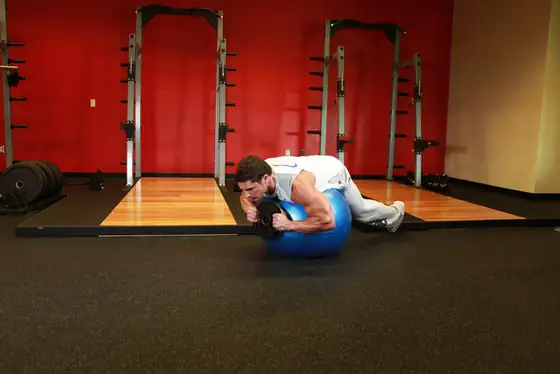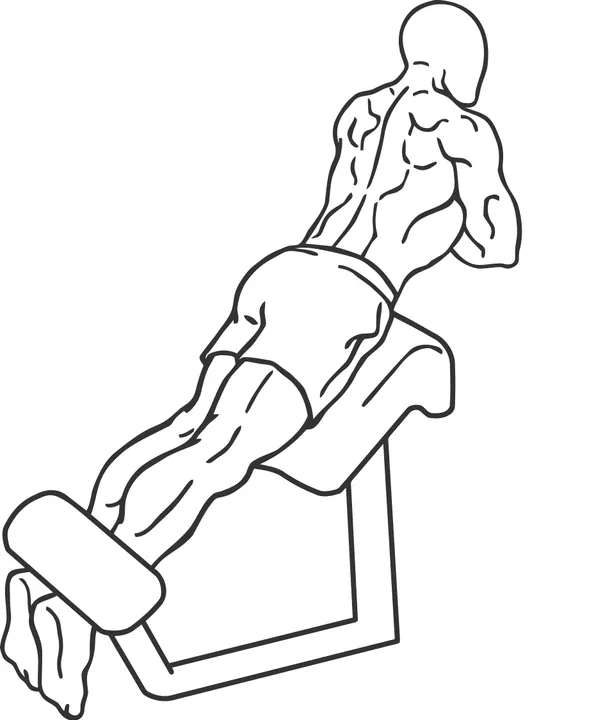
Hyperextensions (Back Extensions) — start position
Start
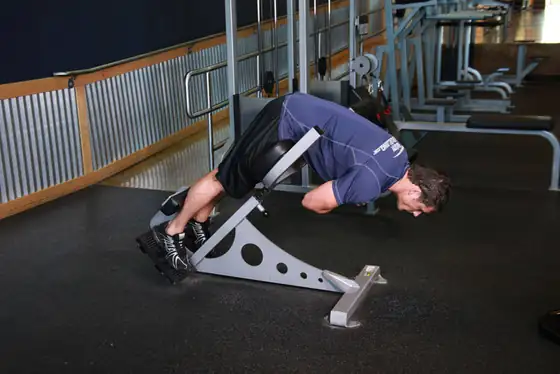
Hyperextensions (Back Extensions) — end position
End

Back / Beginner / Isolation (single joint)

Hyperextensions (Back Extensions)

An isolation bodyweight exercise for the lower back, with the glutes and hamstrings assisting.

At a glance

Primary
Lower back (erectors)
Secondary
Glutes, Hamstrings
Equipment
Bodyweight
Movement pattern
Spinal extension
Level
Beginner
Type
Back, Isolation (single joint)

Loads the lower back. Use a load you can control and skip it if it causes pain.

How to do it

  1. Lie face down on a hyperextension bench, tucking your ankles securely under the footpads.
  2. Adjust the upper pad if possible so your upper thighs lie flat across the wide pad, leaving enough room for you to bend at the waist without any restriction.
  3. With your body straight, cross your arms in front of you (my preference) or behind your head. This will be your starting position. Tip: You can also hold a weight plate for extra resistance in front of you under your crossed arms.
  4. Start bending forward slowly at the waist as far as you can while keeping your back flat. Inhale as you perform this movement. Keep moving forward until you feel a nice stretch on the hamstrings and you can no longer keep going without a rounding of the back. Tip: Never round the back as you perform this exercise. Also, some people can go farther than others. The key thing is that you go as far as your body allows you to without rounding the back.
  5. Slowly raise your torso back to the initial position as you inhale. Tip: Avoid the temptation to arch your back past a straight line. Also, do not swing the torso at any time in order to protect the back from injury.
  6. Repeat for the recommended amount of repetitions.

Common mistakes

  • ✗ Swinging up past straight into a big arch.

    Why it hurts: Hyper-extending the lumbar spine at speed pinches the facet joints.

    ✓ Instead: Rise until the body forms a straight line and stop there.

  • ✗ Pad set too high, at the waist.

    Why it hurts: The hips cannot hinge, so all the bending comes from the lower back.

    ✓ Instead: Set the pad just below the hip crease so you fold at the hips.

Open in the appGet started

Muscles worked

Neck (Front)Upper traps (Front)Front delts (Front)Side delts (Front)Chest (Front)Serratus anterior (Front)Biceps (Front)Forearms & grip (Front)Abs (Front)Obliques (Front)Hip flexors (Front)Quads (Front)Adductors (Front)Shins (tibialis) (Front)Calves (Front)Outer shins (peroneals) (Front)Feet (arch & toes) (Front)Neck (Back)Upper traps (Back)Upper back (rhomboids, mid/lower traps) (Back)Rear delts (Back)Side delts (Back)Rotator cuff (Back)Lats (Back)Lower back (erectors) — primary (Back)Triceps (Back)Forearms & grip (Back)Hip abductors (glute med) (Back)Glutes — secondary (Back)Hamstrings — secondary (Back)Adductors (Back)Calves (Back)
FrontBack
  • Primary: Lower back (erectors)
  • Secondary: Glutes, Hamstrings

Best for

How specific this exercise is to each movement.

Similar exercises

Photos and instructions: free-exercise-db (github.com/yuhonas/free-exercise-db), public domain.