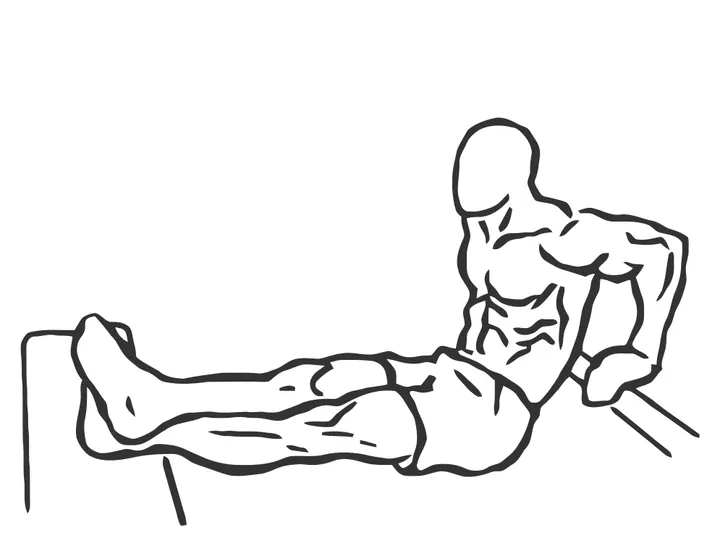
Bench Dip — start position
Start
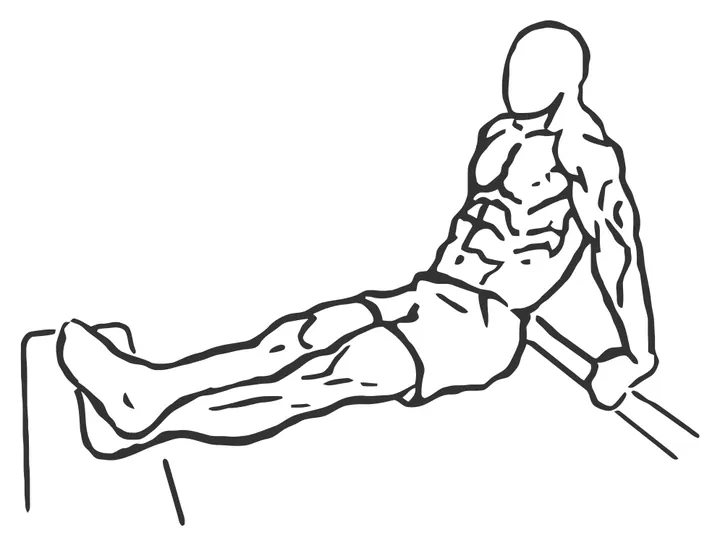
Bench Dip — end position
End

Arms / Beginner / Compound (multi-joint)

Bench Dip

A triceps dip performed between two benches with the feet elevated.

At a glance

Primary
Triceps
Secondary
Front delts, Chest
Equipment
Bench
Movement pattern
Elbow extension, Straight-arm pull (shoulder extension)
Level
Beginner
Type
Arms, Compound (multi-joint)

Loads the shoulder. Use a load you can control and skip it if it causes pain.

How to do it

  1. Place two benches parallel, sit on one and put your heels on the other.
  2. Place your hands on the bench edge beside your hips and slide your hips forward off the bench.
  3. Bend your elbows to lower your body until your upper arms are about parallel to the floor.
  4. Press back up to straight arms.

Tips

  • Do not go below 90 degrees at the elbow; it stresses the shoulders.
  • Keep your back close to the bench.

Common mistakes

  • ✗ Hands behind the body with the hips drifting away from the bench.

    Why it hurts: The shoulder is forced into deep extension and internal rotation, a well-known cause of front-shoulder pain.

    ✓ Instead: Keep the back close to the bench and use a small range. People with shoulder pain are better off with pushdowns or close-grip push-ups.

Open in the appGet started

Muscles worked

Neck (Front)Upper traps (Front)Front delts — secondary (Front)Side delts (Front)Chest — secondary (Front)Serratus anterior (Front)Biceps (Front)Forearms & grip (Front)Abs (Front)Obliques (Front)Hip flexors (Front)Quads (Front)Adductors (Front)Shins (tibialis) (Front)Calves (Front)Outer shins (peroneals) (Front)Feet (arch & toes) (Front)Neck (Back)Upper traps (Back)Upper back (rhomboids, mid/lower traps) (Back)Rear delts (Back)Side delts (Back)Rotator cuff (Back)Lats (Back)Lower back (erectors) (Back)Triceps — primary (Back)Forearms & grip (Back)Hip abductors (glute med) (Back)Glutes (Back)Hamstrings (Back)Adductors (Back)Calves (Back)
FrontBack
  • Primary: Triceps
  • Secondary: Front delts, Chest

Best for

How specific this exercise is to each movement.

Similar exercises

Illustration: Everkinetic (everkinetic.com), CC BY-SA 4.0.