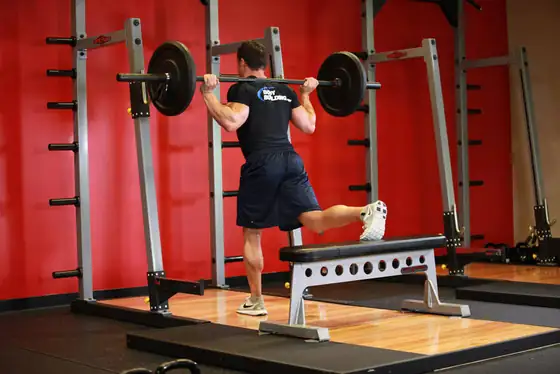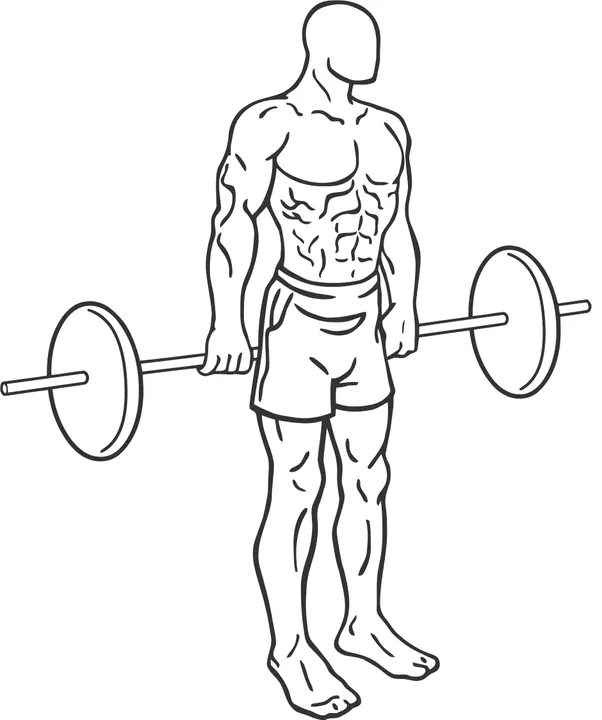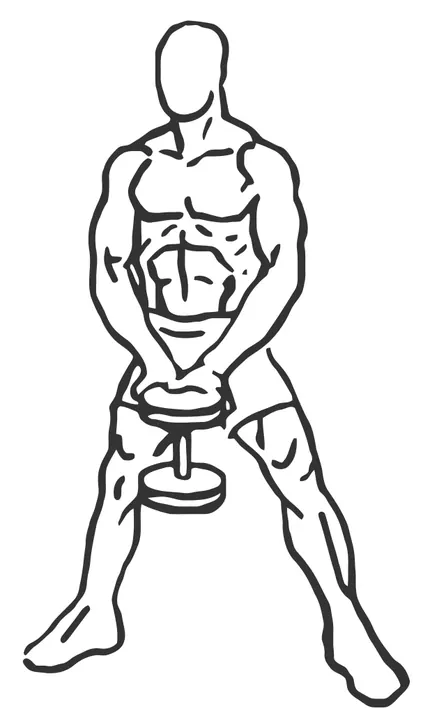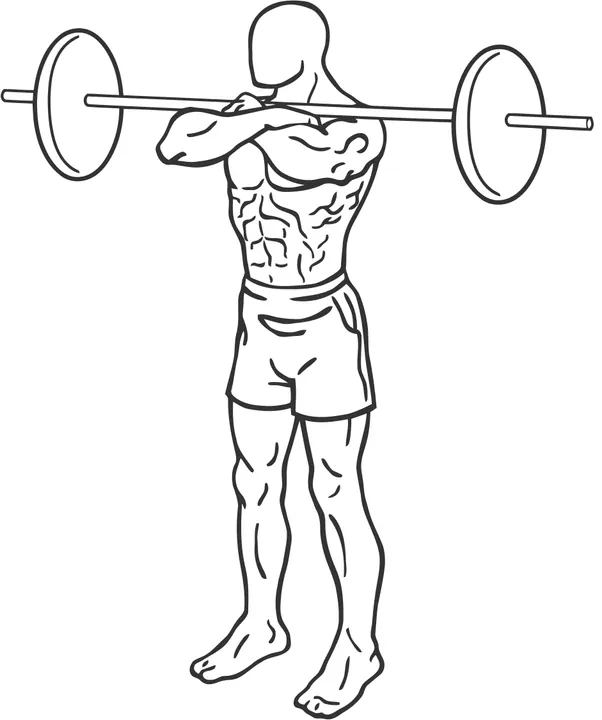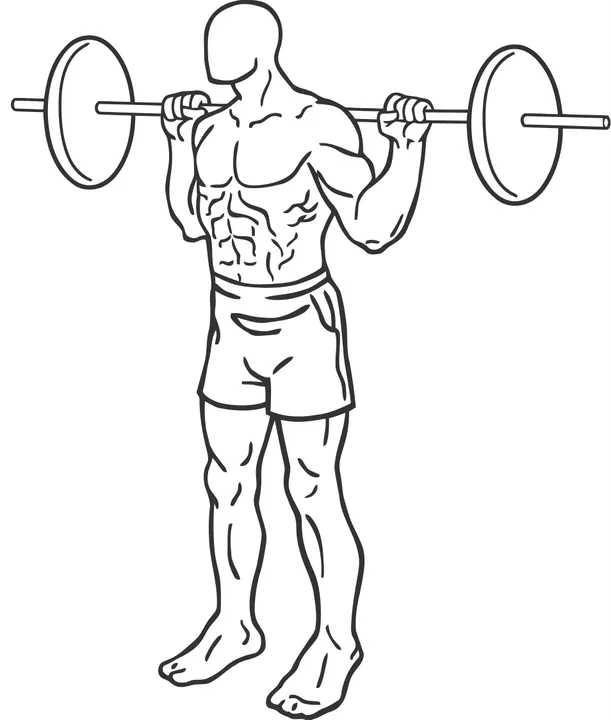
One Leg Barbell Squat — start position
Start
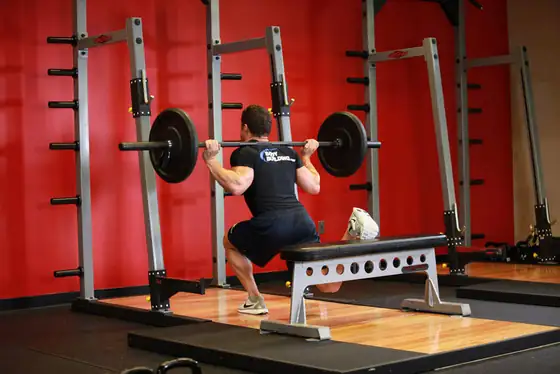
One Leg Barbell Squat — end position
End

Legs / Advanced / Compound (multi-joint)

One Leg Barbell Squat

A barbell exercise for the quads, with the calves, glutes and hamstrings assisting.

At a glance

Primary
Quads
Secondary
Calves, Glutes, Hamstrings
Equipment
Barbell
Movement pattern
Squat
Level
Advanced
Type
Legs, Compound (multi-joint), One side at a time, Balance / unstable

Loads the knee. Use a load you can control and skip it if it causes pain.

How to do it

  1. Start by standing about 2 to 3 feet in front of a flat bench with your back facing the bench. Have a barbell in front of you on the floor. Tip: Your feet should be shoulder width apart from each other.
  2. Bend the knees and use a pronated grip with your hands being wider than shoulder width apart from each other to lift the barbell up until you can rest it on your chest.
  3. Then lift the barbell over your head and rest it on the base of your neck. Move one foot back so that your toe is resting on the flat bench. Your other foot should be stationary in front of you. Keep your head up at all times as looking down will get you off balance and also maintain a straight back. Tip: Make sure your back is straight and chest is out while performing this exercise.
  4. As you inhale, slowly lower your leg until your thigh is parallel to the floor. At this point, your knee should be over your toes. Your chest should be directly above the middle of your thigh.
  5. Leading with the chest and hips and contracting the quadriceps, elevate your leg back to the starting position as you exhale.
  6. Repeat for the recommended amount of repetitions.
  7. Switch legs and repeat the movement.

Common mistakes

  • ✗ Collapsing into the bottom with the knee caving in.

    Why it hurts: All body weight rests on one knee at end range, twisting it and loading the ligaments.

    ✓ Instead: Build up with box pistols to a height you control, keeping the knee over the middle toes.

  • ✗ Heel lifting off the floor.

    Why it hurts: Weight shifts onto the forefoot and the knee takes the load.

    ✓ Instead: Hold a light counterweight in front of you, or put a small plate under the heel while ankle mobility improves.

Open in the appGet started

Muscles worked

Neck (Front)Upper traps (Front)Front delts (Front)Side delts (Front)Chest (Front)Serratus anterior (Front)Biceps (Front)Forearms & grip (Front)Abs (Front)Obliques (Front)Hip flexors (Front)Quads — primary (Front)Adductors (Front)Shins (tibialis) (Front)Calves — secondary (Front)Outer shins (peroneals) (Front)Feet (arch & toes) (Front)Neck (Back)Upper traps (Back)Upper back (rhomboids, mid/lower traps) (Back)Rear delts (Back)Side delts (Back)Rotator cuff (Back)Lats (Back)Lower back (erectors) (Back)Triceps (Back)Forearms & grip (Back)Hip abductors (glute med) (Back)Glutes — secondary (Back)Hamstrings — secondary (Back)Adductors (Back)Calves — secondary (Back)
FrontBack
  • Primary: Quads
  • Secondary: Calves, Glutes, Hamstrings

Best for

How specific this exercise is to each movement.

Similar exercises

Photos and instructions: free-exercise-db (github.com/yuhonas/free-exercise-db), public domain.